
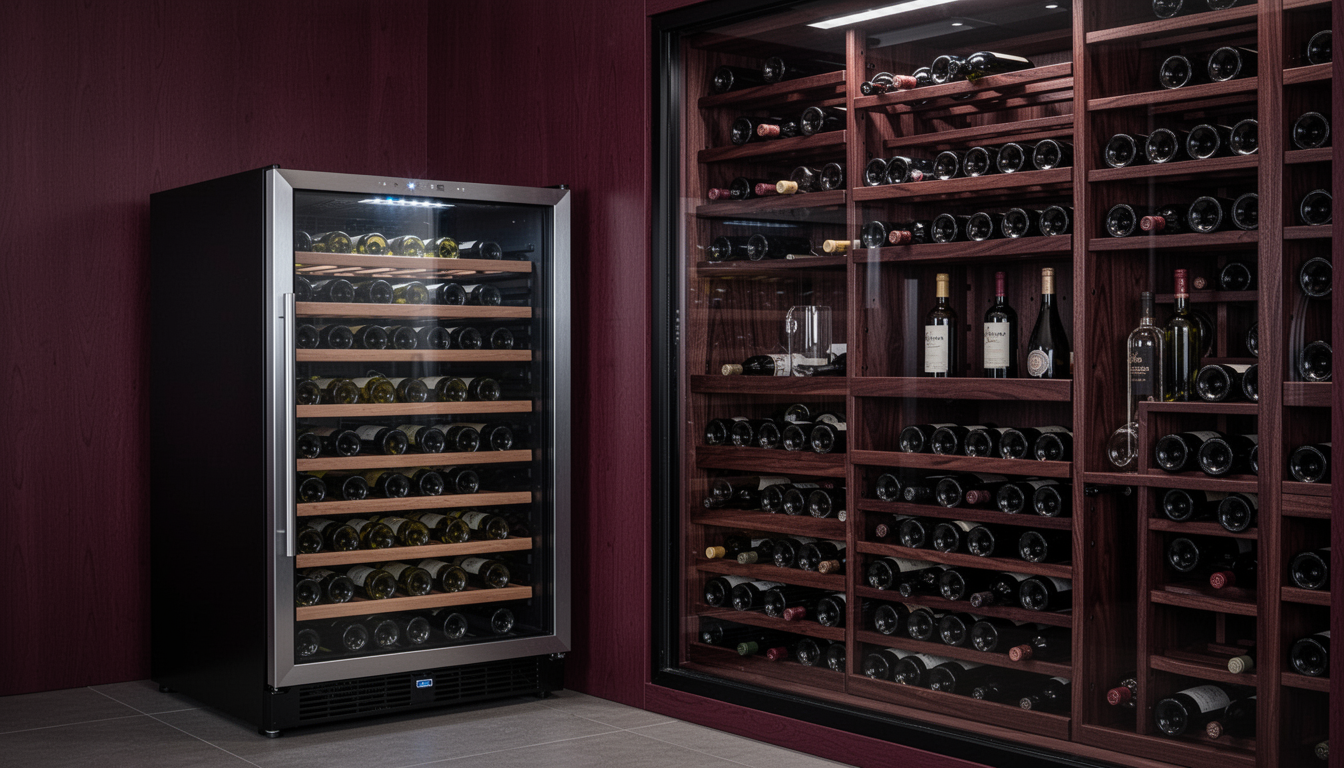
Wine fridge storage can be a sensible way to keep a small group of bottles close at hand. It gives a collector more control than a kitchen cabinet and can make everyday access convenient. But a wine fridge is not the same as a purpose-built vault, especially when a collection must be protected through New England seasons, documented carefully, and expanded over time.
The right choice depends on what your bottles need today and what you expect your collection to become. Use the following comparison to decide when home wine bottle storage is appropriate and when a professional wine storage facility offers a stronger foundation.
When wine fridge storage makes sense
A wine fridge is useful for bottles you plan to enjoy in the near term, or for a focused selection that fits comfortably in a controlled part of the home. It can help reduce exposure to kitchen heat, direct sunlight, and frequent household temperature changes. It also keeps bottles accessible when you want to select a wine for dinner or a tasting.
Its limitations matter just as much as its convenience. A residential appliance depends on household power, the surrounding room, and the reliability of its controls. It may not provide the level of humidity management, security, monitoring, inventory support, or long-term capacity that a serious collection requires. Wine fridge storage is a tool, not a complete cellar-management strategy.
How home storage compares with a professional facility
Begin with stability. Ask how temperature is measured, how often it is checked, and what happens during an equipment or power failure. In Boston and across New England, a facility should be prepared for hot summers, cold winters, and interruptions that a collector cannot manage from a distance. International Wine Vault states that its facilities maintain 55°F and 70% humidity, supported by redundant sensors, on-site and remote monitoring, and backup generators.
Next, consider the environment around the bottles. Light, vibration, and repeated handling can complicate long-term preservation. IWV describes light-free rooms with motion-activated LED lighting, while customer storage is kept separately and each unit is individually secured and alarmed. Review the details of any facility through its wine storage security and amenities information rather than assuming every storage room offers the same protection.
Then look at management. A fridge may hold bottles, but it will not tell you which case is ready to drink, where a particular vintage is located, or what has moved in and out of the collection. IWV uses CellarTracker to catalog bottles, locations, values, drinkability, and tasting notes. A system that combines physical custody with wine inventory and cellar management can make a growing collection more useful, not merely more secure.
Finally, assess scale and handling. A home appliance has a fixed footprint and requires you to move bottles yourself. Professional storage can support collections ranging from one case to 5,000 bottles, with private and bulk storage options. If bottles are arriving from another state, being consolidated from Napa, or moving during a household relocation, ask how packing, pickup, and delivery are coordinated. Specialized wine transport can help keep the move aligned with the collection's storage plan.
Signs your collection has outgrown the home
Capacity is only one warning sign. Your collection may need a different solution when bottles are stacked where labels cannot be read, inventory records no longer match the shelf, or you avoid buying wines because there is nowhere appropriate to put them. Repeated temperature swings, a damp or overly dry room, exposure to light, and uncertainty about security are also reasons to reassess.
- You cannot locate a bottle without searching multiple rooms or boxes.
- Cases are stored in areas that are difficult to keep stable year-round.
- You need to track value, drinkability, provenance, or tasting notes.
- Home access is becoming a burden during a move, renovation, or estate transition.
- You need room for new purchases without compromising existing bottles.
What to verify before choosing a wine storage facility
Request clear answers before moving a collection. Confirm the stated temperature and humidity targets, sensor redundancy, monitoring, backup power, light control, security practices, and how customers' bottles are separated. Ask how access works, what handling services are available, and whether the facility can support both a small initial deposit and future growth.
Also ask how inventory is created and maintained. A useful process should identify each bottle and its location, then make updates practical when bottles are received, moved, opened, or shipped. Finally, understand the relationship between storage and transport so bottles are not exposed unnecessarily during pickup, delivery, or a larger relocation.
A practical decision for Boston and New England collectors
Keep a wine fridge for convenient access to a limited group of bottles if it is operating reliably and the surrounding conditions are stable. For a collection that represents meaningful value, requires detailed records, or must age through New England's changing seasons, compare that appliance with a professional vault on controls, custody, security, management, and scalability.
International Wine Vault has facilities in Framingham and Stoughton, Massachusetts, as well as Napa Valley. A conversation about your collection, access needs, and future plans can help determine whether home storage remains suitable or whether professional wine storage is the more measured next step.